
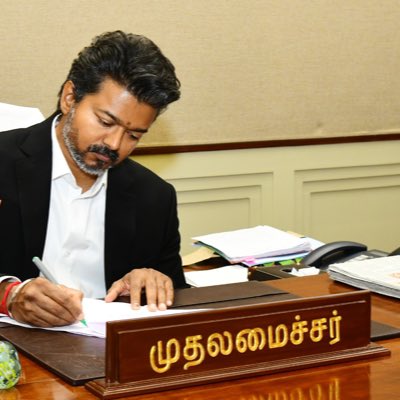
Governor Rajendra Vishwanath Arlekar administered the oath to Vijay and nine other TVK leaders. Among the notable attendees were Congress leader Rahul Gandhi (with whom Vijay shared a widely circulated selfie), actress Trisha Krishnan, and representatives from alliance partners. Vijay’s swearing-in comes just days after his party, the Tamilaga Vettri Kazhagam (TVK), secured a strong performance in the 2026 Tamil Nadu Assembly elections.
Rise from Silver Screen to Secretariat
Born on June 22, 1974, in Chennai, Vijay is the son of filmmaker S.A. Chandrasekhar and playback singer Shoba Chandrasekhar. He began his career as a child artist in the 1980s and rose to superstardom in Tamil cinema as “Thalapathy” (commander/leader), a moniker that fans now carry into the political realm. Known for blockbuster hits like Ghilli, Pokkiri, Thuppakki, Mersal, Leo, and his final film Jana Nayagan (2026), Vijay built a massive pan-Tamil and global diaspora fan base through high-octane action, dance, and socially themed roles.
He announced his retirement from films in late 2025 to focus fully on politics after launching TVK in 2024. The party positioned itself as a fresh alternative emphasizing social justice, secularism, Tamil pride, and anti-corruption — themes that resonated strongly with voters disillusioned with the long-dominant DMK and AIADMK.
In his electoral debut, TVK won around 108 seats (reports vary slightly on exact tally), emerging as the single largest party and forming a majority government with support from Congress, VCK, CPI, CPI(M), and IUML. This coalition-building phase involved intense negotiations, underscoring Vijay’s rapid adaptation to realpolitik.
Immediate Actions and First SignalsHours after taking oath, Chief Minister Vijay convened a high-level meeting with senior bureaucrats and police officials to review the law and order situation, signaling an action-oriented start. In his maiden address, he described the moment as a “new beginning” for Tamil Nadu and pledged governance centered on secularism, social justice, and people-centric policies.
Analysis: What Vijay’s Victory MeansFan Base as Political Capital: Vijay’s unprecedented mass appeal, built over three decades in cinema, translated into electoral success. His fans, often from diverse socio-economic backgrounds, provided a ready volunteer network and emotional connect that traditional parties struggled to match. This “star power” phenomenon echoes past South Indian leaders like M.G. Ramachandran and N.T. Rama Rao, but in a more contemporary, social media-amplified context.
Disruption of Dravidian Duopoly: TVK’s breakthrough challenges the bipolar dominance of DMK and AIADMK. By focusing on youth, welfare, and Tamil identity without heavy reliance on caste-based mobilization (though alliances were key), Vijay has introduced a new variable in state politics. However, sustaining this beyond the “honeymoon” phase will test his administrative acumen.
Challenges Ahead: Critics point to limited prior political experience and organizational hiccups (such as the 2025 Karur rally tragedy). Governing a coalition in a state with complex welfare expectations, industrial growth needs, and federal relations with the Centre will require deft balancing. Economic revival, employment for youth, and maintaining social harmony are likely early priorities.
Broader Implications: Vijay’s win highlights the continuing influence of celebrity in Indian politics while raising questions about the preparedness of film stars for governance. Supporters see it as a refreshing infusion of energy; skeptics warn of the risks of personality-driven politics.As Thalapathy Vijay steps into his biggest role yet, the eyes of Tamil Nadu — and India — are on whether the on-screen hero can deliver real-world change. His journey from “Ilaya Thalapathy” to Chief Minister has already inspired millions; the true test begins now in the corridors of power.